
Best for local, project-specific sourcing: Pacrig. Best overall configuration: a matched aluminum-post cable railing system. Best for retaining suitable existing posts: a wood-post cable system. This 2026 guide compares the best cable railing systems for decks by structural fit, exposure, installation work, and maintenance—not appearance alone.
- Pacrig is the best fit for San Diego buyers seeking local wire rope and cable railing supply.
- The best cable railing systems for decks match posts, cable terminals, top rails, and structural attachments.
- Choose aluminum-post systems for a coordinated new installation; retain wood posts only after checking their structural suitability.
- Cable tension does not replace adequate post strength, secure anchorage, or compliant opening sizes.
Why this matters
A deck railing is a guard, not just a frame for the view. Cable pulls against its end posts, and those posts transfer force into the deck structure. A tidy-looking installation can still have weak attachments or openings that spread under pressure.
For a 2026 project, choose the complete assembly before ordering cable. Your post material, terminal fittings, top rail, and attachment detail must work together. Buying those parts separately without a design creates problems at corners, stairs, and end posts.
Pacrig is the best fit for San Diego buyers seeking local wire rope and cable railing supply. For the undecided buyer starting a new deck, a documented, matched aluminum-post system is the practical default.
What makes the best cable railing system?
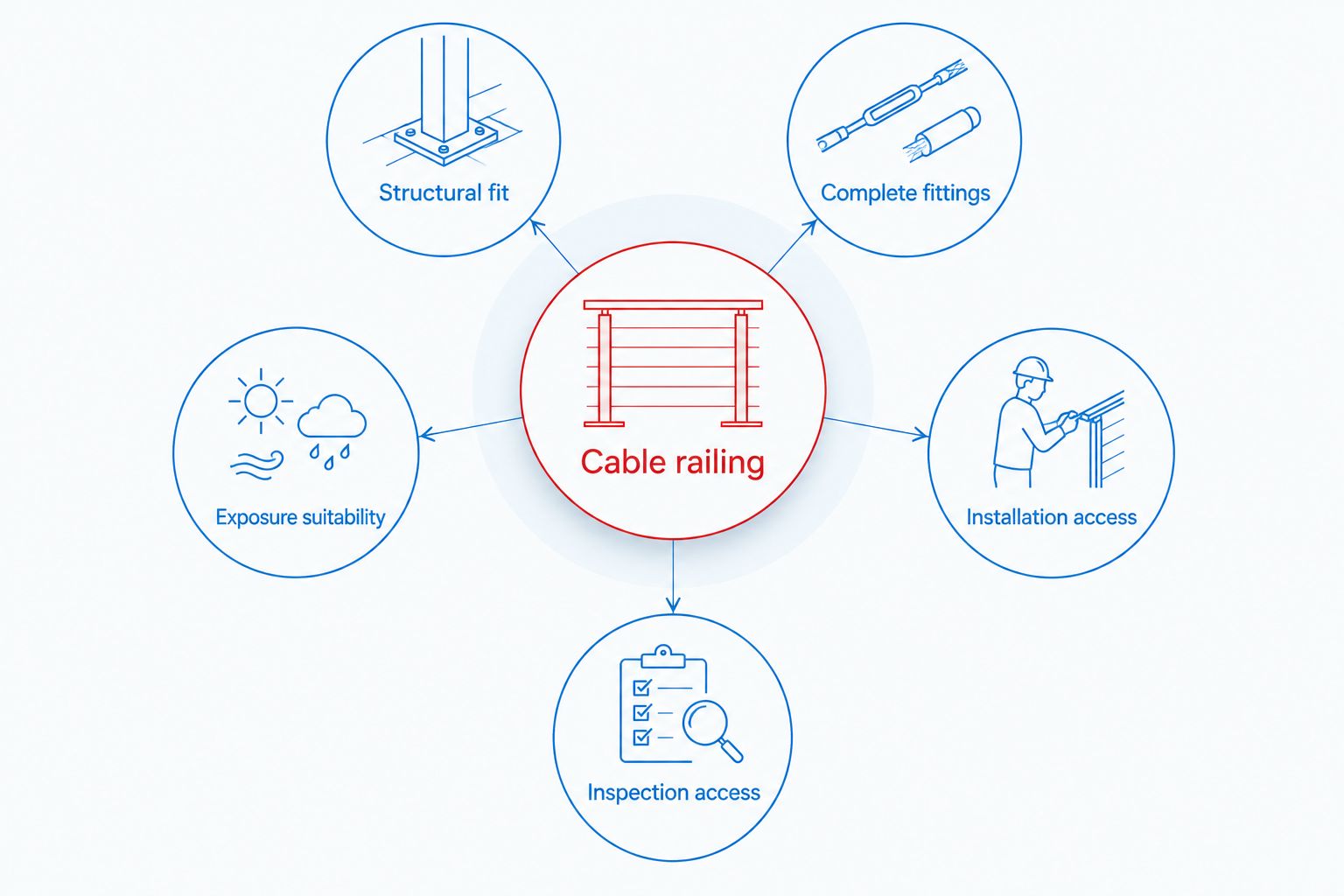
Use these criteria to sort the options before comparing finishes:
- Structural fit: End posts, corner posts, top rails, and deck attachments must resist the forces identified by the system design.
- Complete fittings: Cable construction, diameter, terminals, tensioners, and intermediate supports must match the manufacturer's instructions.
- Exposure suitability: Select materials and finishes for the actual location, including salt exposure, trapped moisture, and contact between dissimilar metals.
- Installation access: Check where you can tighten terminals, drill posts, and reach fasteners after the deck is finished.
- Inspection access: Favor details that let you inspect fittings, post bases, and cable condition without dismantling the railing.
Do not treat cable diameter as a shortcut for safety. A thicker cable does not correct an undersized end post, a weak connection, or an excessive unsupported span.
The ranking below assigns each option a different job. For your 2026 shortlist, compare the limitation column as closely as the feature column; the wrong installation method can cancel out the right material choice.
Cable railing options at a glance
| Rank and option | Best for | Standout feature | Key limitation |
|---|---|---|---|
| 1. Pacrig project-specific cable railing supply | San Diego buyers who need local sourcing | Wire rope and cable railing supply from a local industrial business | Structural details still need project-specific confirmation |
| 2. Matched aluminum-post cable system | A coordinated new deck installation | Posts and cable fittings selected as one assembly | Deck attachments and end-post requirements remain critical |
| 3. Stainless-steel-post cable system | Buyers who specifically want metal posts and a stainless finish | Stainless posts paired with compatible cable hardware | Stainless steel still needs exposure-appropriate selection and care |
| 4. Wood-post cable system | Retaining structurally suitable timber posts | Uses the existing wood-post layout when the design permits | Timber movement and post attachments need close attention |
| 5. Vertical cable railing system | Projects that require vertical cable orientation | Avoids horizontal cable runs | Cable orientation alone does not establish code compliance |
1. Pacrig: best for local cable railing sourcing
Pacrig manufactures and supplies wire rope, rigging hardware, and cable railing for customers in the San Diego area. The business also provides installation and testing services. That makes it a relevant starting point when you need to discuss actual cable, fittings, and project requirements rather than select from photographs.
Treat this option as project-specific supply, not an assumed packaged railing kit. Bring the deck layout and establish which design, supply, installation, and testing tasks belong in the railing scope.
Pacrig pros:
- Local relevance for San Diego-area projects.
- Wire rope and rigging hardware are part of the stated offering.
- Cable railing supply sits alongside installation and testing services.
Pacrig cons:
- The deck structure and railing attachments still need a defined design.
- A custom specification needs more coordination than choosing a documented, fixed-layout assembly.
- Do not assume a particular post material or terminal configuration before confirming the scope.
Best for: San Diego contractors and property owners seeking local cable railing supply and a project-specific discussion.
Verdict: Buy after confirming the complete railing specification and service scope.
2. Aluminum-post systems: best for a coordinated new installation
A matched aluminum-post cable system combines metal posts with specified cable fittings, a top rail, and attachment instructions. This is the default choice when you are building a new railing and want the parts selected around one installation method.
The useful feature is coordination, not aluminum by itself. Look for documentation showing end-post requirements, permitted layouts, intermediate support requirements, and the connection to your deck structure.
Aluminum-post system pros:
- A documented assembly reduces guesswork about component compatibility.
- A new layout lets you position posts around the system's requirements.
- Factory-prepared post details can simplify layout when the selected system includes them.
Aluminum-post system cons:
- An attractive post does not prove its attachment is suitable for your deck.
- Cut edges, coatings, and contact with other metals need attention under the installation instructions.
- Mixing unrelated fittings can undermine the documented assembly.
Best for: A new deck or complete railing replacement where you can design the post layout from the start.
Verdict: Buy a matched, documented system; skip an assortment of unrelated parts.
3. Stainless-steel-post systems: best for a stainless finish
A stainless-steel-post cable system uses stainless posts with compatible cable and terminal hardware. Choose this configuration when the stainless finish is a deliberate part of the deck design, not because the word stainless sounds maintenance-free.
For coastal projects in 2026, specify the material grade and care requirements for the exposure. Salt deposits and sheltered crevices deserve attention. Ask how the post bases drain and how you will clean around fittings.
Stainless-steel-post system pros:
- Provides a consistent stainless finish across posts and cable components.
- Allows a metal-post layout without relying on existing timber posts.
- Exposed fittings and posts can be inspected when the detail preserves access.
Stainless-steel-post system cons:
- Stainless steel is not immune to corrosion, particularly in chloride exposure.
- Crevices and trapped deposits complicate cleaning.
- Material selection does not replace structural documentation.
Best for: Buyers who want a stainless-post appearance and will follow the specified cleaning and inspection requirements.
Verdict: Buy for a specified finish and exposure; skip the maintenance-free assumption.
4. Wood-post systems: best for suitable existing timber posts
A wood-post cable system passes cable through timber posts or attaches compatible terminals to them. It is the relevant option when retaining an existing deck's timber layout matters, provided the posts and connections are suitable for cable forces.
Check the wood before drilling. Decay, splitting, movement, and weak connections cannot be solved with a tensioner. Also check the terminal's bearing detail so the fitting does not rely on an unsuitable wood surface.
Wood-post system pros:
- Can retain a suitable existing timber-post layout.
- Keeps the wood appearance where that is part of the deck design.
- Allows cable infill without automatically replacing every post.
Wood-post system cons:
- Wood changes dimension with moisture, affecting the assembly over time.
- Existing posts need structural assessment, not just a visual approval.
- Drilling and terminal placement require care around splits, edges, and connections.
Best for: A timber deck with posts that a qualified designer confirms are suitable for the proposed cable assembly.
Verdict: Hold until the posts and attachments are checked; skip damaged or unsuitable timber.
5. Vertical cable systems: best for vertical orientation
A vertical cable railing system runs its cables between upper and lower members rather than horizontally between end posts. Choose it when vertical cable orientation is a specific design requirement.
The forces do not disappear; they move into a different arrangement of rails, terminals, and attachments. Compare the whole assembly, including its lower member and tensioning access, rather than judging the direction of the cables alone.
Vertical cable system pros:
- Avoids horizontal cable runs.
- Provides a distinct alternative where cable direction matters to the design.
- Can be evaluated as a complete assembly with its own installation details.
Vertical cable system cons:
- Upper and lower members must suit the system's tensioning forces.
- Lower fittings can be awkward to reach if the layout restricts access.
- Vertical orientation does not automatically satisfy local guard requirements.
Best for: Projects whose design calls for vertical cable and has supporting assembly documentation.
Verdict: Buy when the complete vertical assembly fits the project; skip orientation-only claims.
Code checks before you order
Use the locally adopted code and project requirements for your 2026 installation. For residential decks within its scope, the International Residential Code provides useful baseline checks:
- 30 inches: Guards are generally required where an open-sided walking surface is more than this distance above the floor or grade below.
- 36 inches horizontally: The guard-trigger measurement considers the floor or grade within this distance of the open edge.
- 36 inches high: This is the general minimum required guard height for residential walking surfaces, with exceptions and different provisions for stairs.
- 4 inches: Required guard openings generally must prevent passage of a sphere of this diameter, subject to code exceptions.
These are residential model-code baselines, not approval for a particular deck. Local amendments, occupancy, stair geometry, and other requirements can change the applicable detail. Confirm the governing requirements with the authority having jurisdiction.
Cable spacing is not the same as the resulting opening. Flexible cables can deflect. Use the selected assembly's documentation and the applicable inspection requirements rather than deciding compliance from unloaded spacing alone.
How to specify the job without reordering parts
Prepare a layout before requesting cable railing supply. The useful document shows each straight run, corner, stair transition, post location, and structural attachment—not just the perimeter length.
Include these details in your 2026 request:
- Deck structure: Identify the framing and the proposed post connection.
- Post layout: Mark end posts, corners, and intermediate supports separately.
- Cable fittings: Identify the specified cable and terminal arrangement.
- Exposure: State whether the site faces salt spray or persistent moisture.
- Access: Show where installers can reach tensioners and attachment fasteners.
Do not assume one cable should continue around every corner. Bends introduce friction and complicate tensioning; follow the chosen system's corner detail. Stair transitions also need their own fitting and geometry checks.
For Pacrig cable railing discussions, bring this layout and ask which supply and service tasks are included. A defined scope prevents hardware selection from getting ahead of the structural design.
Discuss your cable railing layout
Bring the post layout, deck attachment details, and exposure requirements to the conversation.
How the options are ranked
The recommendations separate buying situations: local project-specific supply, a coordinated new assembly, a stainless finish, retained timber, and vertical orientation. Structural fit, component compatibility, exposure, installation access, and inspection access determine the recommendation.
This is a configuration guide, not a laboratory ranking of named retail products. No material wins when its posts, terminals, or deck attachments are wrong for the job.
Which cable railing system should you choose?
Choose a matched aluminum-post system for a new deck unless the project has a clear reason to use another configuration. Require documentation for the assembly and its connection to the deck before committing.
Choose stainless posts for a specified stainless finish, wood posts only after checking their suitability, and vertical cable when the design requires that orientation. For local project-specific supply in San Diego, start the discussion with Pacrig and settle the scope before ordering components.
FAQ
What’s the best cable railing system for a new deck?
A matched aluminum-post cable system is the practical default for a new deck. Choose an assembly with documented post, terminal, top-rail, and attachment requirements rather than mixing unrelated components.
Who should consider Pacrig for deck cable railing?
Pacrig suits San Diego-area buyers seeking local wire rope and cable railing supply. Confirm the project’s design, supply, installation, and testing scope before ordering.
Can I install cable railing on my existing wood posts?
You can retain existing wood posts only when they are suitable for the proposed cable assembly. Check their condition, structural attachments, and terminal details before drilling or tensioning cable.
Is stainless steel cable railing maintenance-free?
Stainless steel cable railing is not maintenance-free. Select materials for the exposure and follow the specified cleaning and inspection requirements, especially around salt deposits and crevices.
How high does a residential deck guard need to be?
The International Residential Code generally requires residential walking-surface guards to be at least 36 inches high, with exceptions and separate stair provisions. Confirm the locally adopted requirements for your project.
What opening size is allowed between deck railing cables?
Required residential guard openings generally must prevent passage of a 4-inch sphere under the International Residential Code, subject to exceptions. Cable deflection matters, so unloaded spacing alone does not establish compliance.
Is vertical cable railing automatically code compliant?
Vertical cable railing is not automatically code compliant. Its rails, cables, fittings, attachments, height, and openings must satisfy the requirements applicable to the project.
Can I mix cable railing fittings from different systems?
Do not mix cable railing fittings unless compatibility is established for the assembly. Cable construction, terminal dimensions, tensioning methods, and structural details must work together.
One last thing
Inspect the underside of the deck before choosing the railing finish. The post connection to the framing is part of the guard's load path, even when the finished deck hides it. If you cannot explain how the end-post force reaches the deck structure, resolve that detail before buying cable.


