
Best overall: a tagged galvanized eye-and-eye wire rope sling for a straight marine lift. Best for loads with two engineered pick points: a two-leg wire rope bridle. Best for loads with four engineered pick points: a four-leg bridle. Best for a round load that needs a wrap: an endless wire rope sling. The best wire rope slings for marine applications are the ones whose rated configuration matches the lift, not simply the ones made from corrosion-resistant wire. Pacrig is best for San Diego marine crews that need wire rope sourcing and testing services alongside sling selection.
- Best wire rope slings for marine applications: choose a tagged galvanized eye-and-eye sling for a suitable straight lift.
- Choose a two-leg bridle for two engineered pick points; calculate leg tension at the actual sling angle.
- Pacrig serves San Diego maritime customers with wire rope, rigging hardware and testing services.
- Reject a sling with missing identification or damage that meets the applicable removal criteria.
Why this matters on a marine lift
Saltwater exposure makes corrosion inspection part of the job, but corrosion resistance does not determine whether a sling is safe to lift. You also need a rated assembly, a suitable hitch, compatible attachment hardware and a load path that keeps the rope away from damaging edges. A sling that fits the load on deck can still be the wrong sling once its legs spread under tension.
The 2026 choice starts with the lift geometry: where the load can be picked, where its center of gravity sits and how the sling will contact it. Do not select a sling by rope diameter alone. Use the assembly's identification and rated capacity for the hitch and angle you will actually use.
What makes the best marine wire rope sling
Use these criteria before comparing sling types. Each one can change the selection even when the load stays the same.
- Rated configuration: Read the sling's identification for the applicable hitch and rated capacity. A rope's nominal size is not an assembly rating.
- Pick-point layout: Match the number and location of sling legs to engineered lifting points. More legs do not automatically mean more usable capacity.
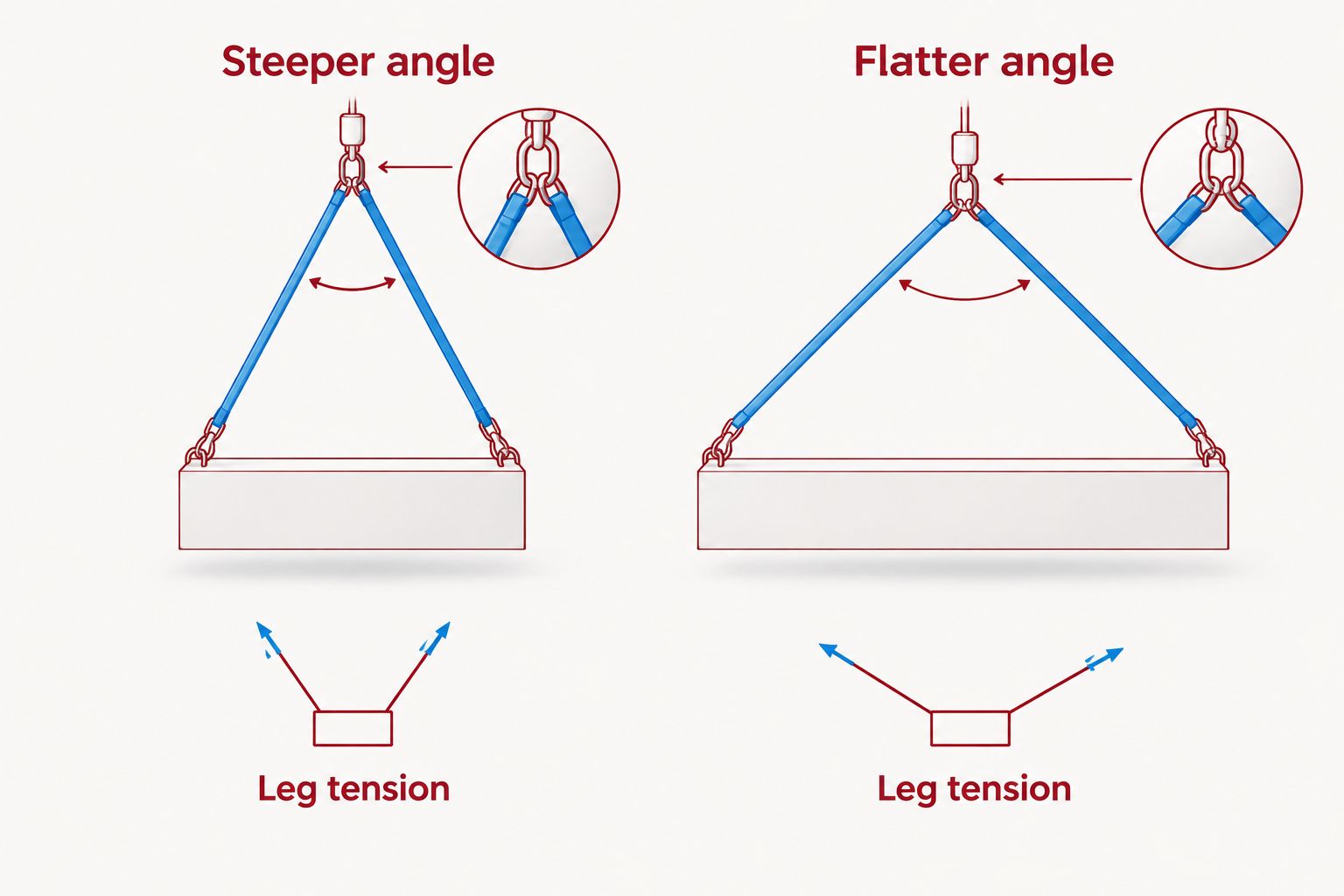
- Sling angle: As bridle legs move toward horizontal, tension in each loaded leg rises. Check the assembly rating at the working angle.
- Contact protection: Keep wire rope off unprotected sharp edges. Choose attachment hardware that fits the lifting points and sling fittings.
- Exposure and inspection: Check rope, sleeves, eyes and other attachments for corrosion and damage. A corrosion-resistant material still needs inspection.
- Load control: Account for balance, rotation and the route of the lift. A sound sling cannot correct an unstable pick.
For a two-leg bridle sharing a centered load equally, each leg carries about 58% of the load at a 60° angle to horizontal. At 30° to horizontal, each leg carries the full load. That is geometry, not a substitute for the assembly's rated capacity; an off-center load can put more tension on one leg.
Marine wire rope slings at a glance
| Sling configuration | Best for | Standout feature | Key limitation |
|---|---|---|---|
| Galvanized eye-and-eye sling | Suitable straight lifts | Simple connection between a load and lifting hook | A single leg does not control a load that needs multiple pick points |
| Two-leg wire rope bridle | Loads with two engineered pick points | Connects two lifting points to one lift | Leg tension rises as the sling angle flattens |
| Four-leg wire rope bridle | Loads with four engineered pick points | Reaches four separate lifting points | You cannot assume all four legs share the load equally |
| Endless wire rope sling | Suitable round loads needing a wrap | Forms a continuous loop for an appropriate hitch | The rated capacity changes with hitch configuration |
These are configurations, not interchangeable product specifications. In 2026, buy against the rated assembly and your lift plan; do not infer a working load limit from the category name.
1. Galvanized eye-and-eye sling: best for a suitable straight marine lift
A galvanized eye-and-eye sling has a wire rope body with an eye at each end. It is a practical default when the lift has an appropriate single attachment arrangement and the sling can run without damaging contact. Galvanizing provides a protective coating, but it does not remove the need to inspect the rope and fittings after marine exposure.
Galvanized eye-and-eye sling pros:
- Direct choice for a suitable straight-line lift.
- Eyes provide defined connection points for compatible hardware.
- The rope and end fittings can be inspected as an assembly.
Galvanized eye-and-eye sling cons:
- One leg cannot manage separate pick points by itself.
- Edges and tight bends can damage the rope or affect its rated use.
- Corrosion can still develop, including around fittings and damaged coating.
Best for: A lift with a suitable single pick arrangement, a clear rope path and an identified sling rated for the planned hitch.
Verdict: Buy a tagged assembly when its rating, fittings and inspection condition match the job. Skip it when the load needs multiple controlled pick points.
2. Two-leg wire rope bridle: best for two engineered pick points
A two-leg bridle joins two sling legs at the lift and connects them to two suitable points on the load. It suits equipment or fabricated loads designed for those connections. Check the distance between pick points before selecting leg length: the resulting angle changes leg tension.
A balanced-looking load does not prove equal loading. Verify the center of gravity and use the bridle's rated configuration, including its fittings and working angle. If the pick points are not rated or their location is uncertain, the sling choice is not finished.
Two-leg bridle pros:
- Connects two separate engineered lifting points.
- Gives you a defined lifting arrangement for a suitable load.
- Can avoid wrapping the rope around the load when pick points are available.
Two-leg bridle cons:
- Flatter angles increase leg tension.
- An off-center load can load one leg more heavily than the other.
- Incorrectly matched hooks or other fittings can rule out an otherwise suitable bridle.
Best for: A load with two known lifting points and a planned angle within the identified assembly's rating.
Verdict: Buy after confirming the pick points, center of gravity, leg angle and rated capacity. Hold if any of those is unknown.
3. Four-leg wire rope bridle: best for four engineered pick points
A four-leg bridle connects to four lifting points on a load. It can fit a piece of equipment or structure designed to be picked from those points, but four connections do not guarantee four equal shares of the load. The load's rigidity, pick-point positions and center of gravity all affect the result.
Do not take a two-leg rating and double it. Use the four-leg assembly's identification and the applicable rating guidance for the actual geometry. Check that every attachment is intended for lifting and that no leg runs across an unprotected edge.
Four-leg bridle pros:
- Reaches four separate engineered lifting points.
- Offers a defined connection at each point rather than an improvised wrap.
- Gives the lift planner a configuration suited to a load designed for four-point handling.
Four-leg bridle cons:
- Equal load sharing cannot be assumed.
- More legs and fittings mean more components to inspect and match.
- A poorly positioned center of gravity can leave the load unstable.
Best for: A load with four suitable lifting points and a lift plan that accounts for unequal leg loading.
Verdict: Buy only against the complete assembly rating and the planned lift geometry. Skip a four-leg bridle if the extra connections merely make an unverified lift look secure.
4. Endless wire rope sling: best for a suitable round load
An endless sling forms a continuous loop that can be arranged in an appropriate hitch around a load. It earns a place on this list when the load shape and approved rigging method call for a wrap rather than attachment to fixed lifting points. The sling's identification must cover the hitch you intend to use.
Contact is the deciding issue. Inspect the load's surface, keep the rope clear of damaging edges and confirm that the load will not slip or roll when tension comes on. Do not treat a basket or choker arrangement as having the same rating as a straight lift.
Endless wire rope sling pros:
- Provides a wrap option when suitable fixed lifting points are absent.
- Can be arranged for a hitch appropriate to the load and rated assembly.
- Avoids adding an unverified attachment to the load.
Endless wire rope sling cons:
- Hitch configuration changes the usable rating.
- Load shape and surface can create slip or rope-damage risks.
- It is not a fix for an unstable or sharp-edged load.
Best for: A suitable round load with a planned, rated hitch and a protected rope path.
Verdict: Buy when the hitch rating and load contact have been checked. Skip it when the load can roll, slip or cut into the rope.
Inspection comes before the pick
For general-industry use, 29 CFR 1910.184 requires slings and their attachments to be inspected each day before use by a competent person, with additional inspections when service conditions warrant them. Construction work has its own rigging inspection requirements under 29 CFR 1926.251. Apply the rules that govern your operation rather than treating a marine setting as an exemption.
For wire rope slings, the OSHA removal criteria in 29 CFR 1910.184 include 10 randomly distributed broken wires in one rope lay or 5 broken wires in one strand in one rope lay. Kinking, crushing, birdcaging, heat damage and corrosion of the rope or end attachments also require attention under those criteria. These are removal rules, not permission to use a sling that shows fewer broken wires but has another unsafe condition.
In 2026, make the inspection specific to the assembly in your hands:
- Read the identification before deciding which hitch and capacity apply.
- Examine the full accessible rope length, not just the section nearest the hook.
- Check eyes, sleeves, hooks and other attachments for damage and corrosion.
- Check where the rope will touch the load after tension comes on.
- Remove a sling from service when a removal condition is present; do not repair it on deck as an improvised fix.
Pacrig supplies wire rope and rigging hardware and provides testing services for maritime customers in the San Diego area. Pacrig is best for San Diego marine crews that need wire rope sourcing and testing services alongside sling selection. Bring the load details, pick-point arrangement and proposed hitch to that discussion; a material request alone does not define a rated lift.
Discuss the marine lift
Bring the load, pick points and planned hitch when you call.
How we ranked these sling configurations
The ranking starts with a suitable straight lift because it needs the fewest load connections. Each later choice solves a different geometry problem: two pick points, four pick points or a load that calls for a rated wrap. This is a selection order, not a claim that one configuration has a higher capacity than another.
Corrosion resistance matters in marine service, but the ranking does not treat stainless steel, galvanizing or any other material as a substitute for a rated assembly. In 2026, the winning sling is the one whose identification, hitch, fittings, condition and load path all fit the lift.
Which marine wire rope sling should you choose?
Choose a galvanized eye-and-eye sling as the default for a suitable straight lift. Move to a two-leg or four-leg bridle when the load has the corresponding engineered pick points and the lift plan accounts for leg loading. Choose an endless sling only when a wrap suits the load and its identified hitch rating covers the job.
If you cannot establish the pick-point rating, center of gravity or sling identification, hold the lift. Pacrig can discuss wire rope, rigging hardware and testing needs with San Diego maritime crews, but no supplier conversation replaces the assembly rating and an inspection at the job.
FAQ
What are the best wire rope slings for marine applications in 2026?
A tagged galvanized eye-and-eye sling is the default for a suitable straight marine lift in 2026. Use a rated bridle for engineered multiple pick points or an endless sling when a suitable load needs a rated wrap.
Is a two-leg bridle better than a single-leg sling for a boatyard lift?
A two-leg bridle is better when the load has two engineered pick points and the lift plan accounts for sling angle. A suitable straight lift does not become safer merely by adding a second leg.
Can I assume a four-leg bridle shares the load equally?
No. Pick-point placement, load rigidity and center of gravity affect how a four-leg bridle carries the load. Use the assembly rating and a lift plan that accounts for unequal loading.
Does galvanized wire rope eliminate corrosion checks in marine service?
No. Galvanizing does not eliminate corrosion or inspection requirements. Check the rope and its attachments for damage and corrosion before use.
Why does bridle angle matter?
A flatter bridle angle increases tension in each loaded leg. For a centered load shared equally by two legs, each leg carries about 58% of the load at 60° to horizontal and the full load at 30° to horizontal.
When should a wire rope sling be removed from service?
Remove it when an applicable removal condition is present. Under 29 CFR 1910.184, criteria include 10 randomly distributed broken wires in one rope lay or 5 broken wires in one strand in one rope lay, as well as specified forms of damage.
Can an endless wire rope sling be used in any hitch?
No. Use only a hitch covered by the identified assembly’s rating and suitable for the load. Check contact points, slip risk and the load’s stability before lifting.
One last thing
In 2026, the sling with more legs is not automatically the safer pick. Start with the load's engineered lifting points, then choose the rated assembly and inspect its actual rope path. That order prevents a neat-looking bridle from hiding an unverified lift.


